In industrial inspection, failures caused by undetected surface cracks can lead to operational downtime, financial losses, and safety risks. Microcracks in materials or welded joints are often invisible to the naked eye but can develop into structural failures if left unaddressed.
Therefore, Non-Destructive Testing (NDT) methods such as Dye Penetrant Testing (DPT) are used as part of preventive inspection programs to ensure material reliability and fabrication quality.
Basic Concept of Dye Penetrant Testing
Dye Penetrant Testing (DPT) is an NDT method used to detect surface-breaking defects such as fine cracks, porosity, and weld discontinuities.
This method utilizes a liquid penetrant that seeps into small surface openings without damaging the material.
Purpose of DPT Inspection
The primary objective of DPT is to identify surface discontinuities at an early stage so corrective action can be taken before the component enters service.
Types of Detectable Defects
DPT effectively detects surface defects such as microcracks, open porosity, lack of fusion, overlap, and pinholes that are not visible during standard visual inspection.
Working Principle of Dye Penetrant Testing
Capillary Action Mechanism
DPT operates based on capillary action, where the penetrant liquid is drawn into fine surface defects due to surface tension forces.
Role of Developer
After excess penetrant is removed, a developer is applied to draw trapped penetrant back to the surface, creating visible indications.
Indication Evaluation
Defects appear as colored lines or dots, which are then evaluated by an NDT inspector according to applicable standards.
DPT Process Steps
1. Surface Cleaning
The surface must be free from oil, rust, paint, or contaminants to ensure proper penetrant action.
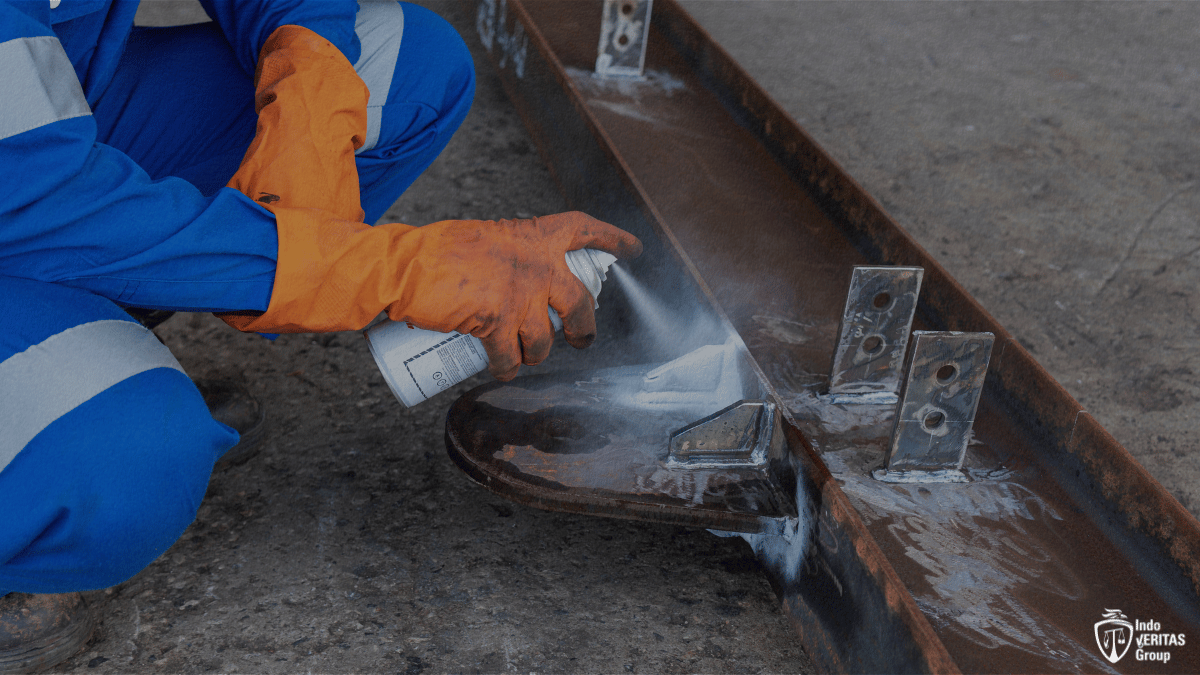
2. Penetrant Application
The penetrant is applied evenly and allowed to dwell for a specified time.
3. Excess Penetrant Removal
Excess penetrant is carefully removed without extracting penetrant from defects.
4. Developer Application
The developer draws penetrant out of defects to form visible indications.
5. Inspection and Interpretation
An inspector evaluates indications based on acceptance criteria.
Types of Dye Penetrant Testing
Visible Dye Penetrant Testing
Uses a colored penetrant (commonly red) visible under normal lighting conditions.
Fluorescent Dye Penetrant Testing
Uses fluorescent penetrant requiring ultraviolet (UV) light, offering higher sensitivity.
Advantages and Limitations
Advantages
- Detects fine surface cracks.
- Simple inspection process.
- Cost-effective.
Limitations
- Detects only surface-breaking defects.
- Highly dependent on surface cleanliness.
Standards and Codes
- ASME Section V
- ASTM E1417 / ASTM E165
- ISO 3452
Industry Applications
- Welding inspection
- Manufacturing and metal fabrication
- Oil & gas, petrochemical, and power plants
Conclusion
Dye Penetrant Testing (DPT) is an effective NDT method for detecting surface defects without damaging materials. When performed according to recognized standards by certified personnel, DPT plays a vital role in maintaining quality and operational safety across industries.
As a professional inspection service provider, Indo Veritas performs DPT in accordance with national and international standards, supported by certified NDT personnel and calibrated equipment.