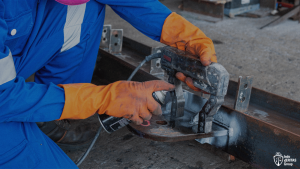

Minor defects that go unnoticed can ultimately lead to major failures. This is where Non-Destructive Testing (NDT) plays a critical role.
Without dismantling or damaging components, NDT helps reveal hidden defects in materials—early, before they escalate into serious problems. For this reason, NDT has become a trusted inspection approach across industries to maintain safety standards and operational performance.
What Is NDT (Non-Destructive Testing)?
Non-Destructive Testing (NDT) is a testing method used to evaluate the physical condition of materials or structures without causing damage. Its primary objective is to detect defects or irregularities such as cracks, corrosion, or porosity that may exist internally or on the surface of a material.
This technique is especially valuable for routine inspections and quality control, particularly in industries that cannot tolerate damage—such as oil & gas, construction, manufacturing, aviation, and energy. NDT enables companies to maintain performance and safety without disrupting ongoing operations.
Types of NDT Methods and How They Work
Each material type and defect condition requires a different inspection approach. Therefore, Non-Destructive Testing (NDT) consists of various methods, each with its own working principles.
Below are some of the most commonly used NDT methods, along with their operating principles, advantages, and limitations:
1. Ultrasonic Testing (UT)
UT works by transmitting high-frequency sound waves into a material. When these waves encounter internal defects such as cracks or voids, the reflected signals differ and are captured by the detection instrument.
Common applications:
- Thickness measurement of pipes and steel plates
- Internal corrosion detection
- Weld inspection
Advantages: High accuracy and suitable for thick materials Limitations: Requires advanced equipment and skilled operators
2. Radiographic Testing (RT)
RT uses X-rays or gamma rays to produce images of a material’s internal structure. This technique is highly effective for identifying hidden defects that are not visible from the outside.
Common applications:
- Inspection of welds in pipes and tanks
- Examination of complex metal structures
Advantages: Provides highly detailed visual images Limitations: Radiation use requires strict safety procedures and higher costs
3. Magnetic Particle Testing (MT)
This method is applied to ferromagnetic materials. A magnetic field is introduced into the material, and magnetic particles are applied to the surface. If cracks are present, the particles gather at the defect location, forming visible indications.
Suitable for:
- Machine components
- Steel weld joints
- Metal structures in heavy vehicles
Advantages: Fast process and relatively low cost Limitations: Effective only on surfaces and ferromagnetic materials
4. Liquid Penetrant Testing (PT)
A penetrant liquid is applied to the material surface and allowed to seep into microscopic cracks. After cleaning, a developer is used to draw out the penetrant, revealing defects that are invisible to the naked eye.
Suitable for:
- Metals
- Ceramics
- Hard plastics
Advantages: Simple and cost-effective Limitations: Limited to surface defect detection
5. Eddy Current Testing (ET)
ET uses electromagnetic induction principles to detect defects. The eddy currents generated will change when disturbances such as cracks or variations in conductivity are present.
Suitable for:
- Crack detection in non-ferrous metals
- Thickness measurement of paint or conductive coatings
Advantages: Fast, accurate, and does not require direct contact Limitations: Limited to conductive materials and requires optimal surface conditions
6. Acoustic Emission Testing (AE)
AE detects acoustic waves generated when a material undergoes deformation or excessive stress. Installed sensors capture these micro-signals and identify potential defects in real time.
Common applications:
- Monitoring pressurized storage tanks
- Gas distribution pipelines
- Structures subjected to heavy loads
Advantages: Can be performed while the system is in operation Limitations: Data requires further interpretation by experienced specialists
Why Is NDT Important in Industry?
The use of NDT offers several key advantages that make it a standard in technical inspection processes:
- Non-destructive to materials: Materials remain intact, allowing for repeated inspections without dismantling or replacement.
- Early defect detection: Cracks, corrosion, or micro-porosity can be identified before developing into major failures.
- Time and cost efficiency: Early prevention helps avoid operational downtime and costly repairs caused by sudden failures.
- Workplace safety: NDT helps identify technical risks that could endanger personnel or production systems.
How to Choose the Right NDT Method?
Selecting the appropriate NDT method depends on several factors, including material type, suspected defect location (surface or internal), environmental conditions, and the required level of accuracy. No single method fits all situations. Therefore, consulting with qualified inspection professionals is highly recommended to determine the most suitable and efficient technique.
Want to learn more about the most appropriate NDT methods for your industrial needs? Contact us today for expert consultation and reliable, effective, and efficient non-destructive testing solutions.